Resistance Welding Training: Skills, Costs, Courses, Careers
Resistance Welding training teaches students and manufacturing professionals how to join metal by applying electrical current and pressure at a controlled contact point. Unlike arc welding, the process normally does not rely on an open arc, continuously fed wire, flux, or a separate filler rod. Heat develops primarily from electrical resistance within the materials and their contact surfaces.
Resistance welding is used extensively in automotive manufacturing, appliance production, aerospace, sheet-metal fabrication, electronics, wire products, and other high-volume industries. The process can create fast, repeatable welds and is well suited to automation, but reliable production requires more than pressing a machine button.
Operators and technicians must understand machine setup, electrode condition, weld schedules, material coatings, part fit-up, cooling systems, quality testing, and equipment safety. Small changes in current, force, timing, alignment, or surface condition can affect the finished joint.
In this guide, I will explain what professional resistance welding instruction covers, the available training options in the United States, expected costs, certification pathways, and the skills required for manufacturing careers.
What Is Resistance Welding?
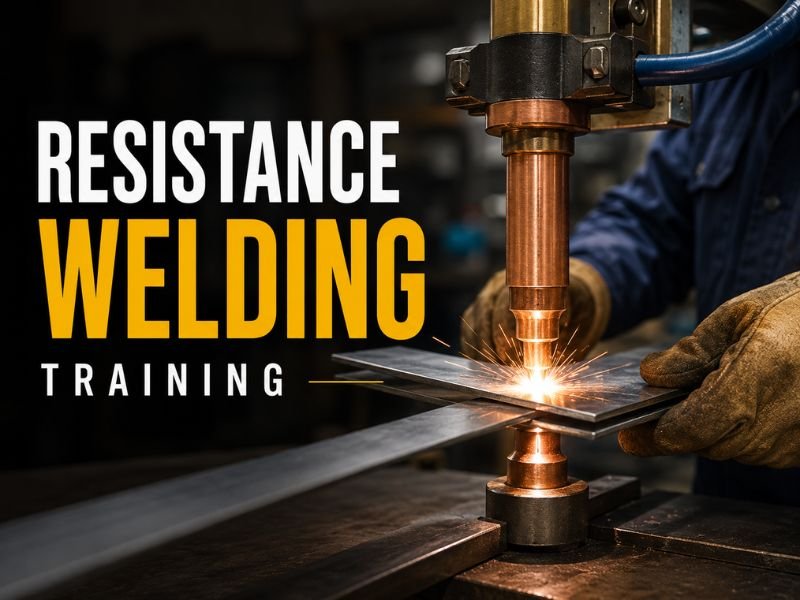
Resistance welding is a group of joining processes that use electrical resistance to generate heat at the interface between metal components. The machine applies force through electrodes while a high electrical current passes through the workpieces.
The combination of current, resistance, pressure, and time creates a localized molten or softened area. The applied force holds the components together as the joint forms and cools.
The process is commonly used on sheet metal, wire, fasteners, and formed components. In many applications, it produces a joint without adding filler metal. Shielding gas is also generally unnecessary because the joint forms between contacting surfaces rather than beneath an exposed welding arc.
Resistance welding machines typically operate with low secondary voltage and very high current. A transformer and welding control regulate energy delivery, while pneumatic, hydraulic, servo-electric, or mechanical systems apply electrode force.
Resistance Welding vs. Arc Welding
Resistance and arc welding both use electrical energy, but they generate and control heat differently.
Arc welding creates an electric arc between an electrode and the workpiece. The arc melts the joint area and usually deposits filler metal. Processes such as SMAW, GMAW, GTAW, and FCAW fall within the arc-welding category.
Resistance welding passes current through contacting workpieces while force is applied through electrodes. Heat concentrates where electrical resistance is greatest, particularly at the interface between the parts.
Arc welding is often preferred for long seams, thick structural components, field repairs, and work requiring manual access. Resistance welding is commonly selected for repetitive sheet-metal assemblies, fast production cycles, automation, and joints that can be reached by suitable electrodes.
A professional training program should help students understand these differences rather than treating resistance welding as a simplified version of spot welding.
Major Resistance Welding Processes
The term resistance welding includes several related processes. Each uses controlled electrical energy and force, but the machine design, electrode geometry, and joint configuration can differ.
Resistance Spot Welding
Resistance spot welding creates individual weld nuggets at specific locations. Two or more overlapping metal sheets are positioned between opposing electrodes. The electrodes clamp the parts, current flows through the stack, and a localized joint forms between the sheets.
Spot welding is widely associated with automotive body structures, metal cabinets, appliances, enclosures, and sheet-metal assemblies. A production component may contain dozens or hundreds of individual spot welds.
Training should cover electrode alignment, tip geometry, sheet thickness, coating condition, current, weld time, force, cooling, and spacing between welds.
Resistance Seam Welding
Resistance seam welding uses rotating wheel electrodes to produce a series of overlapping welds. Depending on the machine settings, the result may be a continuous or intermittent seam.
The process is used for containers, tanks, drums, radiators, fuel-related components, and products that may require a leak-resistant joint.
Students learn how wheel speed, current pulses, electrode pressure, cooling, and overlap affect seam consistency.
Projection Welding
Projection welding concentrates current through raised features, embossed areas, or specially designed contact points. The projections localize heat and help control where each joint forms.
The process is often used to attach nuts, bolts, studs, brackets, cross wires, and other components. Multiple projections may sometimes be welded during one machine cycle.
Training should explain projection design, part alignment, collapse behavior, electrode tooling, force distribution, and the effect of coatings.
Resistance Butt and Flash Welding
Resistance butt welding joins components end to end by applying current and pressure across their contacting faces. Flash welding introduces controlled flashing before the parts are forced together.
These processes may be used for wire, chain, rings, rails, frames, tubing, and similar products. Training is generally specialized because setup depends heavily on part geometry, clamping, upset distance, current control, and machine timing.
What Does Resistance Welding Training Include?
Resistance Welding training should combine process theory, equipment instruction, supervised machine operation, quality evaluation, and preventive maintenance. The ideal curriculum depends on whether the student is preparing to become an operator, maintenance technician, quality specialist, engineer, or supervisor.
An operator-focused course may emphasize safe loading, approved weld schedules, electrode inspection, routine checks, and defect reporting. Technician-level instruction may cover troubleshooting, waveform analysis, tooling, controls, transformers, cooling circuits, and process optimization.
Electrical Resistance and Heat Generation
Students need a practical understanding of how current creates heat within the joint. Heat generation is influenced by current level, electrical resistance, and the duration of current flow.
Current must pass through the electrodes, workpieces, interfaces, and electrical connections. Surface coatings, oxidation, contamination, fit-up, material thickness, and electrode condition can change the resistance within that path.
Excessive heat may cause expulsion, surface damage, electrode sticking, or excessive indentation. Insufficient heat may produce a small weld nugget or an incomplete joint.
Training should connect machine settings to physical results so students can diagnose the process instead of adjusting values randomly.
The Resistance Welding Cycle
A resistance welding cycle commonly includes squeeze, weld, hold, and off time.
During squeeze time, the electrodes close and establish the required force before current begins. Weld time controls how long current flows. Hold time maintains pressure while the joint cools and solidifies. Off time applies to repetitive machines and describes the interval before the next cycle.
Modern controllers may include multiple current pulses, upslope, downslope, preheat, postheat, tempering, or adaptive-control functions. Students should begin with the basic cycle and progress to advanced schedules after understanding the purpose of each stage.
Welding Current
Current is one of the most influential process variables. A setting that is too low may produce inadequate nugget formation, while excessive current can create metal expulsion, electrode damage, deep indentation, or inconsistent results.
Students should learn that increasing current is not always the correct solution. Electrode force, weld time, material condition, tooling, and fit-up must also be evaluated.
Current monitoring can help identify process variation, but a current reading alone does not prove that every joint is acceptable.
Electrode Force
Electrode force holds the workpieces together, establishes electrical contact, contains molten metal, and helps form the joint during cooling.
Insufficient force may contribute to expulsion, unstable contact, or excessive surface heating. Excessive force may reduce interface resistance, deform the components, or require more current to form the desired nugget.
The force must be verified rather than assumed from an air-pressure gauge. Machine friction, cylinder condition, tooling weight, alignment, and mechanical wear can affect the force reaching the workpiece.
Electrode Design and Condition
Resistance welding electrodes carry current, apply force, remove heat, and help control the appearance of the joint. Their material, shape, face diameter, alignment, and cooling strongly influence process performance.
Electrode tips gradually wear, mushroom, pit, or become contaminated. As the contact area increases, current density can decrease and weld quality may change.
Students learn how to inspect, dress, replace, align, and cool electrodes according to approved procedures. Excessive dressing can shorten electrode life, while inadequate maintenance can cause process drift.
Material Preparation and Part Fit-Up
Resistance welding can appear tolerant because it does not require an exposed weld pool, but surface and dimensional conditions remain important.
Oil, adhesive, sealant, scale, corrosion, paint, plating, and metallic coatings can change electrical contact and heat generation. Some coated steels are routinely resistance welded, but they may require specialized schedules and electrode-management practices.
Part gaps can also reduce consistency. The welding machine may spend part of its force closing a gap rather than establishing controlled contact. Poor fit-up can change current paths and increase distortion.
Students should learn to check material identification, thickness, coating type, stack-up, joint overlap, alignment, and surface condition before changing the machine schedule.
Resistance Welding Safety
Resistance welding avoids some hazards associated with open-arc processes, but it introduces significant mechanical, electrical, thermal, and production risks.
Pinch Points and Moving Equipment
Electrodes can apply substantial force. Hands, fingers, clothing, and tools must remain outside the closing area.
Production machines may require guards, barriers, interlocks, two-hand controls, presence-sensing devices, or other protective systems. The correct safeguard depends on machine design and workplace risk assessment.
Training should include safe loading, emergency stops, stored-energy awareness, and procedures for clearing misloaded parts.
Electrical Safety
Resistance welding systems use very high secondary current even though the voltage at the electrodes is relatively low. Primary electrical components, transformers, controls, and internal connections can still present serious hazards.
Only authorized personnel should open electrical cabinets or perform energized diagnostics. Lockout and tagout procedures are essential during servicing, electrode changes when exposure exists, and maintenance involving hazardous energy.
Damaged insulation, loose connections, overheated cables, and water leaks near electrical equipment require immediate attention.
Heat, Sparks, and Metal Expulsion
The welded area, electrodes, and parts may remain hot after the cycle. Excessive settings or poor contact can eject molten metal from the joint.
Operators need appropriate eye and face protection, protective clothing, gloves, and safety footwear based on the process. Screens may be required when sparks or expelled metal can reach other workers.
The work area should be controlled for combustible materials, especially when welding coated parts or when expulsion is possible.
Cooling-Water Systems
Many resistance welding systems use water to control the temperature of electrodes, transformers, cables, and tooling.
Restricted flow can cause overheating, accelerated electrode wear, hose damage, and equipment failure. A water leak can also create slip hazards or affect electrical components.
Technician training should cover flow verification, temperature, hose routing, leaks, scaling, filtration, and the consequences of operating without adequate cooling.
Quality Control and Weld Testing
Visual appearance alone does not confirm the internal size or strength of a resistance weld. Training must therefore include appropriate inspection and testing methods.
Visual Inspection
Visual checks may identify electrode indentation, surface cracking, expulsion, discoloration, misalignment, excessive deformation, or missing welds.
These observations are useful, but an acceptable surface does not guarantee an adequate weld nugget.
Destructive Testing
Common destructive methods include peel, chisel, tension-shear, cross-tension, and metallographic testing. The selected test depends on the material, joint, product standard, and production plan.
A peel or chisel test may expose the joint and provide an indication of nugget size or failure mode. Metallographic examination can reveal nugget geometry, penetration, cracks, voids, and heat-affected regions.
Students should learn how to prepare samples, perform tests consistently, measure results, and document findings.
Process Monitoring
Manufacturing systems may track current, voltage, resistance, force, displacement, energy, or electrode movement. Adaptive controls can modify output when process conditions change.
Monitoring helps identify trends, but limits must be established using validated data. A machine should not be considered capable solely because the controller shows a green indicator.
Quality assurance normally combines qualified schedules, equipment maintenance, production monitoring, sample testing, and traceable records.
Common Resistance Welding Problems
| Problem | Possible Causes | Corrective Direction |
| Small or weak weld nugget | Low current, short weld time, excessive force, poor contact, or worn electrodes | Verify the approved schedule, material condition, force, and electrode geometry |
| Metal expulsion | Excessive current, low force, poor fit-up, contamination, or incorrect timing | Correct the setup and balance current, time, and force |
| Excessive indentation | High force, excessive heat, small electrode face, or soft material | Review electrode design, force, heat input, and material support |
| Electrode sticking | Excessive heat, unsuitable electrode material, contamination, or poor cooling | Inspect the schedule, electrode condition, alignment, and cooling |
| Inconsistent welds | Part variation, worn tooling, changing coatings, unstable force, or cooling problems | Identify the source of variation before adjusting the schedule |
| Rapid electrode wear | High heat, poor cooling, misalignment, unsuitable tip design, or coated material | Improve maintenance and confirm the electrode specification |
A professional course should teach a structured troubleshooting method. The technician first verifies safety, material, tooling, electrodes, force, current, timing, and cooling. Changing several variables simultaneously can hide the original problem.
Resistance Welding Training Options in the United States
Training is available through industry organizations, equipment manufacturers, employers, technical schools, community colleges, and specialized seminars.
The Resistance Welding Manufacturing Alliance offers industry-focused education, including an intensive resistance welding school designed for operators, technicians, supervisors, and engineers. Equipment manufacturers may also provide training on specific controllers, guns, transformers, robotic cells, and monitoring systems.
Employer-based instruction is common because resistance welding equipment is closely connected to a company’s products and production standards. New operators may receive machine-specific training, while technicians complete advanced courses in controls, maintenance, and process troubleshooting.
Community college and technical-school welding programs may introduce spot welding within broader manufacturing or welding curricula. However, not every general welding course provides in-depth resistance welding instruction.
Online training can support theory, terminology, quality concepts, and certification preparation. Hands-on work remains important for electrode maintenance, force measurement, machine setup, testing, and fault diagnosis.
How Long Does Resistance Welding Training Take?
A basic operator course may take several hours or a few days. It can cover safe loading, controls, approved schedules, routine inspection, and defect reporting.
An intensive industry seminar may run for two or more days and include process theory, equipment, applications, quality, and troubleshooting. Technician development can take substantially longer because it includes supervised workplace experience and machine-specific instruction.
Engineers and quality personnel may complete additional study in metallurgy, weld design, statistical process control, standards, automation, and advanced monitoring.
I recommend judging a program by its learning objectives and practical relevance rather than duration alone. A short course can be effective for a defined machine, while a broad technical role requires continuing education and field experience.
How Much Does Resistance Welding Training Cost?
There is no standard national price. Cost depends on the provider, course length, instructor expertise, laboratory access, certification preparation, travel, and equipment specialization.
Employer-based operator instruction may be provided as part of onboarding. Industry seminars, manufacturer courses, and professional certification programs may charge tuition, examination, materials, travel, and lodging separately.
Before registering, confirm whether the price includes laboratory work, course manuals, examination fees, retesting, meals, and continuing-education credit.
The lowest-priced course may not offer the best value if it is too general for the equipment or industry in which you plan to work.
Certification and Professional Credentials
Resistance welding credentials differ from the performance tests commonly associated with manual arc welders.
The American Welding Society offers the Certified Resistance Welding Technician credential. It is intended to validate knowledge related to resistance welding processes, safety, quality, equipment, maintenance, and production.
Certification may benefit technicians, engineers, supervisors, quality personnel, and experienced operators seeking formal recognition of their technical knowledge. Applicants should review current eligibility, examination, renewal, and recertification requirements before applying.
Completing a school course does not automatically provide professional certification. A course certificate documents attendance or completion, while an industry credential may require a separate application and examination.
Employers may also maintain internal qualifications for operators, setup technicians, inspectors, and maintenance personnel.
How to Choose a Resistance Welding Course
First, identify the role you want to perform. An operator needs different training from a controls technician, welding engineer, quality specialist, or robotic-cell programmer.
Review the curriculum and confirm that it covers the processes used in your industry. Automotive spot welding, aerospace resistance welding, projection welding, seam welding, and wire joining can require different standards and equipment knowledge.
The instructor should connect theory with real production problems. Useful training includes machine setup, electrode maintenance, force measurement, testing, cooling, troubleshooting, and documentation.
I recommend asking whether the course uses operating equipment or only classroom presentations. For technical roles, hands-on exercises and actual weld evaluation provide greater value.
Career Opportunities After Training
Resistance welding skills are relevant to automotive production, appliance manufacturing, aerospace, electronics, battery assembly, sheet-metal fabrication, wire products, transportation equipment, and automated manufacturing.
Possible roles include resistance welding operator, setup technician, maintenance technician, quality technician, manufacturing technician, robotic welding operator, process specialist, production supervisor, and welding engineer.
The process is highly automated in many facilities, so employers may also value programmable logic controller knowledge, robotics, electrical troubleshooting, sensors, statistical process control, and preventive maintenance.
Career growth generally depends on a combination of process knowledge and broader manufacturing skills. An operator who learns quality testing, equipment setup, controls, and troubleshooting may progress into a technical or supervisory position.
Frequently Asked Questions
Is Resistance Welding Difficult to Learn?
Basic machine operation can be learned relatively quickly, but controlling weld quality requires an understanding of current, force, time, electrodes, cooling, materials, and part fit-up. Technician-level troubleshooting takes additional training and experience.
Is Resistance Welding the Same as Spot Welding?
No. Spot welding is one type of resistance welding. The broader category also includes seam, projection, butt, and flash welding processes.
Does Resistance Welding Use Filler Metal?
Most common resistance spot, seam, and projection welding applications join the workpieces without a separate filler metal. Specialized resistance processes and applications may differ.
Does Resistance Welding Produce an Arc?
Resistance welding normally forms the joint through resistance heating and pressure rather than a sustained welding arc. Flash welding intentionally creates flashing during part preparation before the final upset.
Can Resistance Welding Be Automated?
Yes. It is widely used with robotic systems, automated fixtures, conveyors, and integrated manufacturing cells. Automation still requires validated weld schedules, maintenance, monitoring, and quality testing.
Can I Learn Resistance Welding Online?
Online training can explain process theory, safety, controls, and quality concepts. Hands-on instruction is still valuable for equipment setup, force measurement, electrode maintenance, testing, and troubleshooting.
Is Certification Required?
Requirements vary by employer and role. Professional certification can demonstrate technical knowledge, while employers may also use internal qualifications and machine-specific training.
Conclusion
Resistance Welding training provides a foundation for operating, maintaining, inspecting, and improving one of the most important joining technologies in modern manufacturing. Effective instruction should cover electrical resistance, weld schedules, electrode force, tooling, cooling, safety, testing, and structured troubleshooting.
Before selecting a program, compare its intended audience, laboratory access, instructor experience, industry relevance, total cost, and certification preparation. I recommend choosing training that connects technical theory with actual equipment and measurable weld quality.
With practical experience and continued technical development, resistance welding knowledge can support careers in automotive production, aerospace, appliances, electronics, robotic manufacturing, quality assurance, and industrial maintenance.