Flux Core Welding Training: Courses, Costs, and Career Guide
Flux Core Welding training teaches students how to join metals using a continuously fed tubular wire electrode containing flux. Formally known as Flux-Cored Arc Welding, or FCAW, the process is widely used in structural steel, shipbuilding, heavy fabrication, construction, equipment manufacturing, and industrial repair.
FCAW combines the productivity of a wire-fed process with many of the benefits associated with flux-based welding. Depending on the wire, the process may use an external shielding gas or rely entirely on ingredients inside the electrode for weld-pool protection.
Professional training involves much more than loading wire and pulling the gun trigger. Students must learn equipment setup, polarity, wire classification, voltage, wire feed speed, joint preparation, slag removal, welding positions, inspection, and defect correction.
In this guide, I will explain what a quality FCAW course should cover, how long training may take, what it can cost, how welding qualifications work, and how to compare programs in the United States.
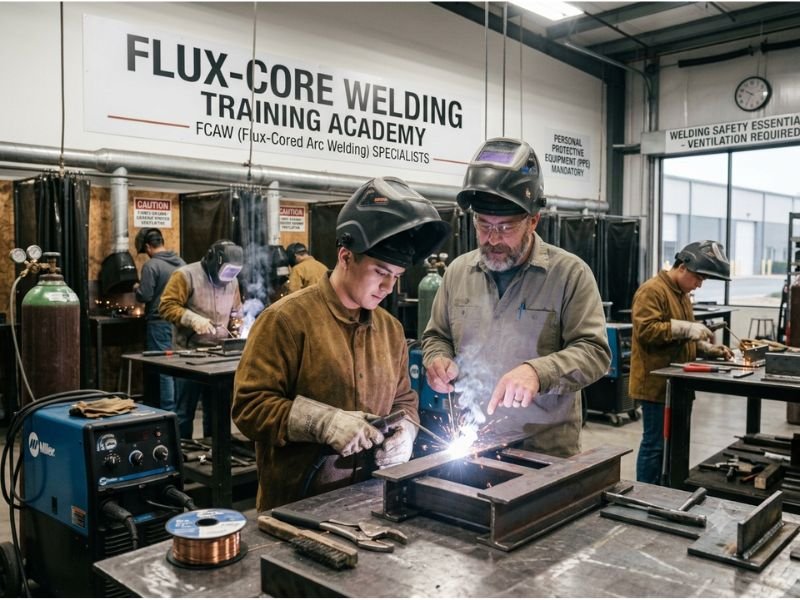
What Is Flux-Cored Arc Welding?
Flux-Cored Arc Welding (FCAW) is a semi-automatic or automatic arc-welding process that uses a continuously fed consumable tubular electrode. The center of the wire contains flux ingredients that help protect and shape the weld.
An electric arc forms between the wire and the workpiece. Arc heat melts the electrode and base metal, producing a molten weld pool. The flux creates protective gases, deoxidizers, alloying elements, or slag, depending on the electrode design.
After the weld cools, a layer of slag normally remains on the surface. The welder must remove this material before inspecting the bead or depositing another pass.
FCAW is often confused with MIG welding because both processes use a wire feeder and welding gun. The key difference is the electrode. MIG welding generally uses solid wire and external shielding gas, while FCAW uses a tubular flux-filled wire and may or may not require external gas.
Self-Shielded vs. Gas-Shielded Flux Core Welding
Students must understand that flux core welding is not a single setup. The two main variations have different equipment requirements, operating characteristics, and applications.
Self-Shielded FCAW
Self-shielded FCAW, commonly identified as FCAW-S, does not require an external shielding-gas cylinder. The ingredients within the wire create the necessary protection around the arc and molten weld.
This portability makes self-shielded wire useful for field construction, structural erection, equipment repair, and other outdoor work. Wind can disrupt an externally supplied gas shield, but FCAW-S is less dependent on calm atmospheric conditions.
Self-shielded wire does not eliminate the need for careful technique. Students still need to follow the manufacturer’s recommendations for polarity, electrode extension, travel angle, voltage, and wire feed speed.
Gas-Shielded FCAW
Gas-shielded FCAW, also called FCAW-G or dual-shield welding, combines a flux-cored electrode with externally supplied shielding gas. Carbon dioxide and argon-carbon dioxide mixtures are commonly associated with various gas-shielded applications, but the correct gas must match the electrode classification and welding procedure.
FCAW-G is often used in fabrication shops, shipyards, manufacturing facilities, and structural production. It can provide high deposition rates, strong penetration, smooth arc characteristics, and good mechanical properties.
Because it depends on external shielding gas, the welding area must be protected from excessive drafts. Gas flow that is too low, too high, or disrupted by wind can contribute to porosity and other weld problems.
Why Learn Flux Core Welding?
FCAW is valuable because it can deposit weld metal quickly while producing strong welds on medium and heavy materials. This combination makes it useful in industries where productivity and structural performance are both important.
Compared with stick welding, FCAW allows more continuous operation because the wire is supplied from a spool or coil. The welder does not need to stop repeatedly to replace short electrodes. This can increase arc-on time and production output.
The process is also versatile. Different wires are available for particular positions, strength levels, shielding methods, and applications. Some electrodes are designed for flat and horizontal work, while others support vertical and overhead welding.
Flux core welding is not automatically the best choice for every project. Slag must be removed, equipment is more complex than a basic stick-welding setup, and incorrect parameters can produce serious defects. Training helps students understand where FCAW is appropriate and how to use it correctly.
What Does Flux Core Welding Training Include?
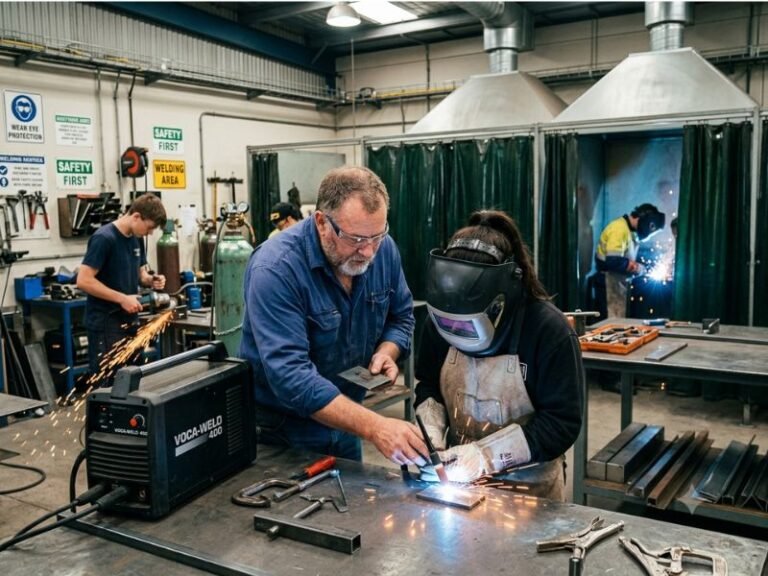
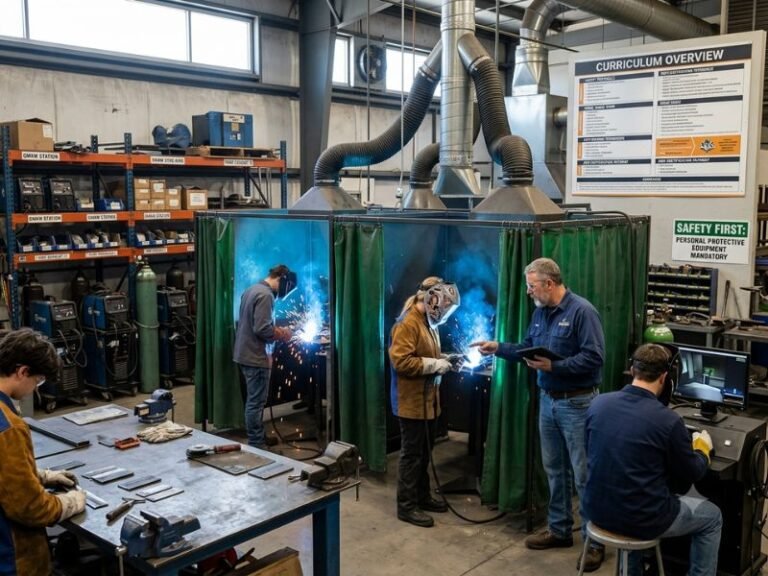
A complete Flux Core Welding training program should combine technical instruction with substantial supervised practice. Students need to understand the process, but they also need enough booth time to develop consistent physical control.
Welding Safety and Fume Control
FCAW produces intense ultraviolet and infrared radiation, sparks, hot metal, fumes, electrical hazards, and noise. Flux-cored wires can generate substantial fumes, especially when welding at high deposition rates or working on coated materials.
Students should learn to evaluate the material, electrode, work area, and ventilation before welding. Local exhaust ventilation or other engineering controls may be necessary to keep fumes away from the breathing zone.
Typical personal protective equipment includes a welding helmet with an appropriate filter shade, safety glasses, dry welding gloves, flame-resistant clothing, and protective boots. Hearing and respiratory protection may also be required after a proper exposure assessment.
Training should address fire prevention, electrical safety, gas-cylinder handling, confined spaces, hot-metal identification, and the hazards of welding painted, plated, galvanized, or contaminated materials.
Understanding FCAW Equipment
A typical system includes a constant-voltage power source, wire feeder, welding gun, contact tip, nozzle, drive rolls, work lead, electrode wire, and related cables. Gas-shielded setups also include a cylinder, regulator, flowmeter, and gas hose.
Students learn how to load wire, route it through the feeder, select suitable drive rolls, set drive-roll pressure, install the correct contact tip, and verify the work connection.
Flux-cored wire can be softer than solid wire, so excessive drive-roll pressure may deform it. Insufficient pressure can cause slipping and irregular feeding. The selected drive rolls must match the wire type and diameter.
Gun liners, contact tips, nozzles, and cables should be inspected regularly. Feeding resistance or damaged consumables can produce an unstable arc even when the machine settings appear correct.
Polarity and Electrical Connections
Polarity is not universal across all flux-cored wires. Some self-shielded products use direct-current electrode negative, while many gas-shielded wires use direct-current electrode positive. The correct polarity is stated by the electrode manufacturer and applicable welding procedure.
Using the wrong polarity can cause excessive spatter, poor penetration, unstable operation, slag problems, and unacceptable mechanical performance.
Students should develop a habit of checking the wire label, machine connections, and procedure before welding. Guessing based on a previous wire is not reliable.
Wire Classification and Selection
Flux-cored electrodes are classified according to factors such as tensile strength, welding position, usability, shielding method, and performance characteristics.
Students do not need to memorize every classification immediately, but they should understand how to read the wire designation and confirm whether it is appropriate for the task.
Wire selection depends on the base metal, required strength, welding position, material thickness, shielding gas, impact requirements, and governing specification. An electrode intended only for flat and horizontal welding should not be used for an all-position procedure.
Storage also matters. Wire should remain dry, clean, and protected from damage. Rust, moisture, dirt, or physical deformation can interfere with feeding and weld quality.
FCAW Machine Settings and Essential Techniques
FCAW depends on a balanced combination of voltage, wire feed speed, travel speed, electrode extension, gun angle, and shielding conditions. A welder who changes settings randomly may create one acceptable-looking bead without understanding whether the weld is sound.
Voltage and Wire Feed Speed
Voltage influences arc length, bead profile, and overall arc behavior. Excessive voltage may create a wide, flat bead, increased spatter, undercut, or poor slag coverage. Insufficient voltage may produce an unstable arc and irregular bead shape.
Wire feed speed affects the rate at which the electrode enters the arc. In a constant-voltage system, increasing wire feed speed generally increases current. This can affect penetration, deposition rate, and heat input.
Students commonly begin with recommended parameter ranges and make controlled adjustments based on wire diameter, material thickness, position, joint design, and observed arc behavior.
Electrode Extension
Electrode extension, often called stickout, is the distance from the contact tip to the end of the wire. It is especially important in FCAW because it affects electrical resistance and how the electrode heats before reaching the arc.
An extension that is too short or too long can change penetration, deposition rate, arc stability, and bead shape. The proper range depends on the wire and procedure.
Students should measure and recognize the correct distance rather than relying only on instinct.
Gun Angle and Direction of Travel
Flux core welding is often performed with a drag or pull technique so the arc leads the slag. A common reminder is that when slag is present, the welder generally drags the gun. However, the actual travel angle must match the electrode and procedure.
The work angle positions the gun between the sides of the joint. The travel angle tilts it in relation to the direction of movement. Incorrect angles can cause poor fusion, slag entrapment, uneven bead shape, or undercut.
Travel Speed and Puddle Control
Travel speed determines how much heat and weld metal are applied to a specific area. Moving too fast can create a narrow bead, undercut, incomplete fusion, or insufficient weld size. Moving too slowly can cause excessive reinforcement, rollover, high heat input, and poor slag behavior.
Students should learn to watch the leading edge of the weld puddle and confirm that the arc reaches both sides of the joint. The slag line should remain behind the active weld pool rather than moving ahead of it.
Welding Positions and Joint Practice
Professional FCAW courses normally begin with flat-position beads and fillet welds before progressing to horizontal, vertical, and overhead work.
Not every flux-cored wire supports every position. The electrode classification and procedure determine whether the wire can be used vertically or overhead.
Fillet Welds
Fillet welds are commonly practiced on T-joints, lap joints, and corner joints. Students learn to maintain equal or specified leg sizes, proper root fusion, a suitable profile, and smooth tie-in at both toes.
The gun must direct enough heat toward each joint member. Unequal angles can produce excessive fusion on one side and lack of fusion on the other.
Groove Welds
Groove-weld training introduces edge preparation, root openings, bevel angles, backing, root passes, fill layers, and caps. Students must clean slag between passes and inspect each layer before adding more weld metal.
Multipass work requires planning. Poor bead placement can create narrow valleys where slag becomes trapped.
Vertical and Overhead Welding
Vertical-up welding is used in many structural applications. Students may practice controlled stringer beads or limited manipulation according to the wire and procedure.
Overhead FCAW requires careful parameter selection, body positioning, protective clothing, and puddle control. The student should not progress to difficult positions without first demonstrating consistency in simpler work.
Common Flux Core Welding Defects
Defect recognition is a critical part of training because an attractive surface does not guarantee adequate fusion or internal quality.
| Defect | Common Causes | Corrective Direction |
| Porosity | Poor gas coverage, drafts, contamination, excessive extension, or damaged equipment | Check gas delivery, clean the joint, inspect connections, and correct technique |
| Slag inclusion | Inadequate cleaning, poor bead placement, low heat, or incorrect angle | Remove slag completely and improve pass placement |
| Lack of fusion | Low heat, excessive travel speed, poor joint access, or incorrect gun angle | Adjust parameters and direct the arc into the joint |
| Undercut | High voltage, excessive speed, or poor gun control | Reduce unsuitable settings and improve toe control |
| Excessive spatter | Incorrect voltage, polarity, extension, or wire feeding | Verify setup and balance the welding parameters |
| Worm tracking | Gas escaping through solidifying slag or unsuitable operating conditions | Follow the wire manufacturer’s parameter and technique guidance |
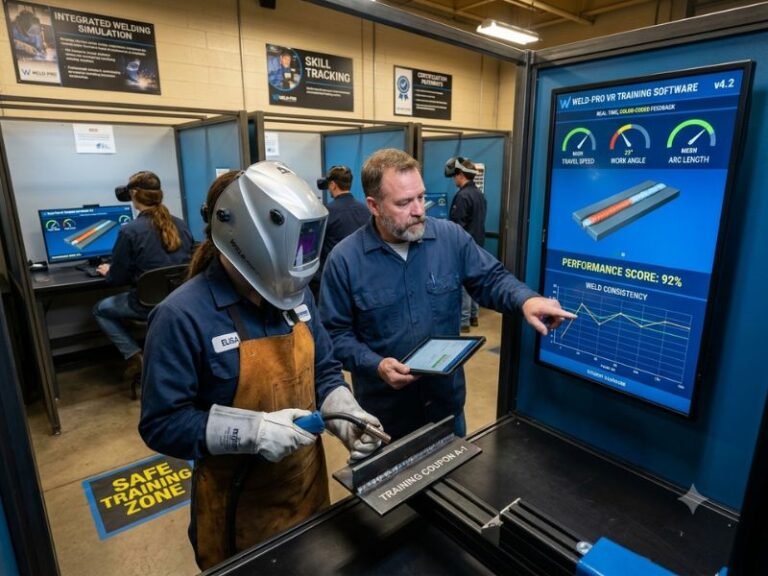
A good instructor should explain why a defect occurred, demonstrate a correction, and observe the student repeating the weld. Simply grinding out every problem without understanding its cause does not build reliable skill.
Flux Core Welding Training Options in the United States
Students can learn FCAW through trade schools, community colleges, apprenticeships, unions, employer programs, and short process-specific courses.
Trade schools often provide intensive career preparation and may combine FCAW with SMAW, GMAW, GTAW, cutting, blueprint reading, and fabrication. Community colleges may offer individual classes, technical certificates, diplomas, or associate degrees.
Apprenticeships combine paid work with structured instruction. They can provide valuable exposure to real construction or fabrication environments, although entry may be competitive.
Employer training is often focused on a specific product, wire, position, or procedure. It can prepare workers effectively for a particular job but may provide less broad experience than a comprehensive welding program.
Online courses can teach theory, wire classifications, safety, setup, and troubleshooting. They cannot replace physical practice or direct correction of gun angle, travel speed, electrode extension, and body position.
How Long Does Flux Core Welding Training Take?
Training length ranges from a short introductory class to a multi-month welding program.
A beginner course may teach safety, machine setup, flat-position beads, and basic fillet welds. A process-specific program may spend several weeks on multiple joints and positions. A comprehensive career program may cover FCAW along with other processes and fabrication skills.
The student’s goal matters. Someone preparing for a production job with one joint may require less time than a structural welder preparing for vertical and overhead qualification tests.
I recommend comparing hands-on lab hours, instructor access, and required competencies rather than choosing a program only because it has the shortest advertised completion time.
How Much Does Flux Core Welding Training Cost?
There is no standard national price. Total costs depend on the institution, location, program length, credential, equipment, and included materials.
Expenses may include tuition, registration, lab fees, books, wire, shielding gas, practice plate, welding PPE, hand tools, qualification testing, transportation, and housing.
Before enrolling, ask for a written breakdown. Confirm whether consumables, open-lab access, safety equipment, testing, and retesting are included.
Financial aid, veterans’ education benefits, workforce funding, scholarships, apprenticeships, or employer assistance may be available to eligible students and programs.
FCAW Certification and Welder Qualifications
Completing Flux Core Welding training does not automatically qualify a student for every FCAW job.
A course certificate confirms completion of a program. A welder performance qualification demonstrates the ability to produce an acceptable test weld under defined conditions.
Those conditions may include the process, electrode classification, shielding gas, base metal, thickness, joint design, position, backing, procedure, and governing code. Passing one test does not provide unlimited qualification for every material or position.
The American Welding Society offers performance-based certification pathways, while employers, unions, contractors, and testing facilities may administer additional tests.
Students should ask which test a course prepares them for, whether testing is included, how the coupon is evaluated, and whether additional fees apply.
How to Choose an FCAW Training Program
Begin by identifying the type of work you want to pursue. Structural construction, shipbuilding, production fabrication, and repair work may use different wires, positions, and qualification standards.
Review the curriculum and confirm that it includes the relevant variation of FCAW. A course focused only on self-shielded wire may not prepare you for gas-shielded fabrication work, and the reverse is also true.
Compare booth time, class size, equipment, instructor experience, ventilation, material availability, and practical testing. I recommend visiting the facility and asking current students how much individual welding time they actually receive.
The school should explain its credentials accurately. Avoid programs that promise guaranteed employment, immediate high wages, or universal certification.
Career Opportunities After FCAW Training
Flux core skills are used in structural fabrication, steel erection, shipbuilding, heavy-equipment manufacturing, trailer production, industrial construction, infrastructure, and repair.
Potential entry-level titles include structural welding trainee, fabrication welder, production welder, shipyard welder, and welder-fitter. Duties may include measuring, fitting, tacking, grinding, reading drawings, and inspecting work in addition to welding.
Workers can strengthen their employment options by learning blueprint reading, layout, thermal cutting, SMAW, GMAW, GTAW, rigging, and basic inspection.
Wages depend on location, industry, experience, qualification, shift, overtime, union status, and travel requirements. Training can improve readiness, but it does not guarantee a particular wage or job.
Frequently Asked Questions
Is Flux Core Welding Easy to Learn?
Basic equipment operation can be introduced relatively quickly because the wire feeds continuously. Producing repeatable, structurally acceptable welds still requires practice, parameter knowledge, and good puddle control.
What Is the Difference Between Flux Core and MIG Welding?
Both are wire-fed arc-welding processes. MIG generally uses solid wire with external shielding gas, while flux core uses a tubular electrode containing flux and may be self-shielded or gas-shielded.
Can Flux Core Welding Be Used Outdoors?
Self-shielded FCAW is commonly used outdoors because it does not depend on external shielding gas. The procedure must still account for weather, moisture, material condition, and safe working conditions.
Does Flux Core Welding Require Gas?
Some forms do and some do not. FCAW-S is self-shielded, while FCAW-G uses an external shielding gas in addition to the flux inside the wire.
Can I Learn FCAW Online?
Online instruction can explain theory, safety, wire selection, and troubleshooting. Hands-on practice is necessary to develop gun control and have weld quality evaluated.
Does Completing a Course Make Me Certified?
Not necessarily. A completion certificate documents training, while a welding qualification requires passing a defined practical test.
Is FCAW Useful for a Welding Career?
Yes. It is widely associated with structural steel, heavy fabrication, shipbuilding, manufacturing, and industrial work. Career opportunities improve when FCAW is combined with fitting, drawing interpretation, and additional welding processes.
Conclusion
Flux Core Welding training can prepare students for demanding work in structural construction, fabrication, shipbuilding, manufacturing, and industrial repair. A strong program should teach both self-shielded and gas-shielded concepts where relevant, along with safety, equipment setup, parameter control, position welding, inspection, and defect correction.
Before enrolling, compare the curriculum, supervised practice time, instructor access, equipment, total cost, and qualification opportunities. I recommend selecting a program that measures demonstrated welding ability rather than attendance alone.
With consistent practice and realistic expectations, Flux Core Welding training can provide a practical foundation for developing productive, job-relevant welding skills.